Work day
A plan for one date, ticking off with the time, and a focus timer on whatever you are doing now.
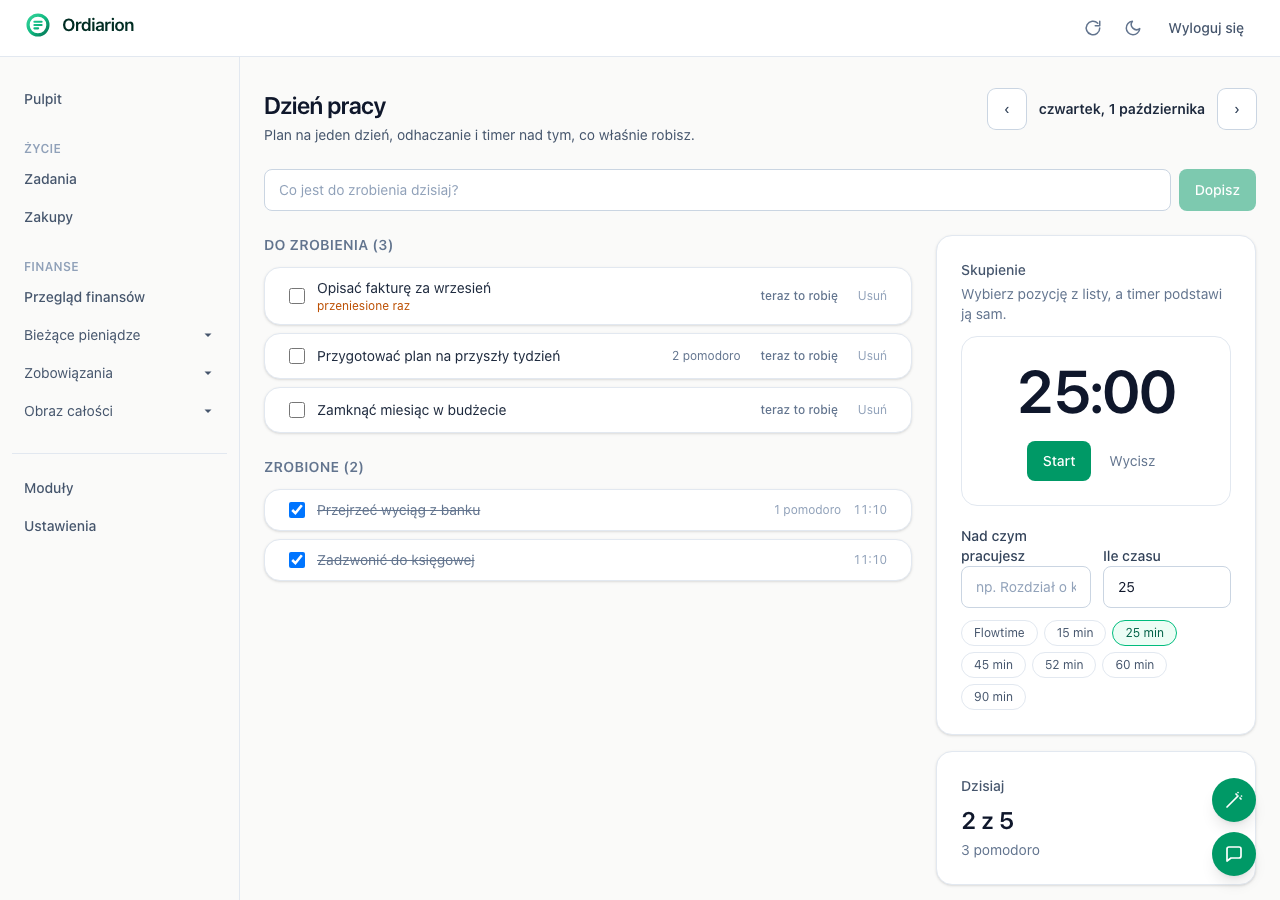
A work day is one sheet for one date: what needs doing, what is already done, and how many focus sessions went into it. Three things that used to be three separate screens, none of which knew about the others.
How this differs from Tasks
A task lives until you do it and has a due date somewhere ahead. A work-day line belongs to one day - tomorrow it is either carried over deliberately or it drops out of sight.
That is not a limitation, it is the whole difference. A task list grows without end and after a month nobody reads it. A day's list holds as much as fits in a day, and in the evening you can see how much of it survived.
Carrying over from earlier days
When something unfinished is left on earlier days, a button appears at the top with the count: "3 unfinished things are left from earlier days". One click moves them to today.
The line moves rather than being copied. Two copies of one thing on two days leave the question "what was planned for Tuesday" with no answer.
The move stays visible: the line gets a note saying "carried 3 times". That is deliberately uncomfortable. Pushing things to tomorrow costs nothing until something counts how often you have done it - and a line on its fourth day is usually not waiting for time, but for a decision about whether it should happen at all.
The timer
Press "working on this" next to a line and the timer on the right fills in its title. When a focus session ends, that line's pomodoro count goes up by one. Breaks do not count, because a break is not work.
It is the same timer as the Pomodoro module and the same sessions: everything counted here lands in that module's history and summaries, and from there - if you want - in Work time.
What the evening shows
In the right-hand column: how many of the planned things are done, and how many focus sessions the whole day took. Finished lines keep the time they were ticked off - not to account for anything, but because after a week it is the only trace from which the real start of the day can be reconstructed.